


Why Trackaswim race reviews work (and why most swimmers don’t improve from “just racing”)
Trackaswim fixes that by giving you a simple, repeatable post race review system you can do in minutes. Over a season, those small reviews become a performance library: patterns show up, confidence grows, and training gets more focused. These reviews come together to give you actionable areas to focus your training with your coach and can be used in the ‘pep talks’ before each race. This page will guide you through the ‘how to analyse a swim race‘ properly to get the best outcome possible for your future races.
Table of Contents
The Trackaswim 5-part race review (your “race results → insight → confidence” loop)
Starts and Dives
Enter analysis for your start. How did it feel? Were you quick off the mark? Did you hear the beep clearly?Underwater
Enter analysis for your underwater work. How did it feel? Did you get all aspects done? Did you come up early?Stroke
Enter analysis for your stroke work. How did it feel? Did you kick hard enough? Did you catch the lane ropes?Turns
Enter analysis for your turns. How did they feel? Did you get too close to the wall? Did you slip? Did you execute your underwater streamline?Finish
Enter analysis for your finish. Did you put your head down and race to the wall? Did you punch the wall hard?When to do it (timing matters)
“If you wait a week, the review becomes a story. If you do it same-day, it becomes a tool.
Step-by-step: how to analyse a swim race in Trackaswim (fast, no overthinking)
Step 1: Ensure that you have logged the race and the official time within Trackaswim. This takes only seconds to do. Then Go to My Meets → select the meet → select the race → open Race Detail.
In Race Detail, add your 5-star ratings for:
Start
Underwater
Stroke
Turns
Finish
A simple rule: 5 stars = “I nailed it!” – 3 stars = “Could have done better because…”
This keeps ratings realistic and stops you chasing perfection. There will be times when you got it perfect, but there will always generally be room for improvement.
Write 1–3 sentences. Try to keep all your reviews in a simple format so that there is consistency across what you write. This helps when looking through and finally determining a training programme to work on. As an example, use this format:
What happened: “Underwaters felt rushed off the start.”
Why it mattered: “I surfaced into traffic and lost rhythm.”
What I’ll try next time: “Hold dolphin kicks to 8–10m before first breath.”
That last line is gold — it turns reflection into action. It shows that you know what you need to do, but you need to work on consistently doing it in a race situation.
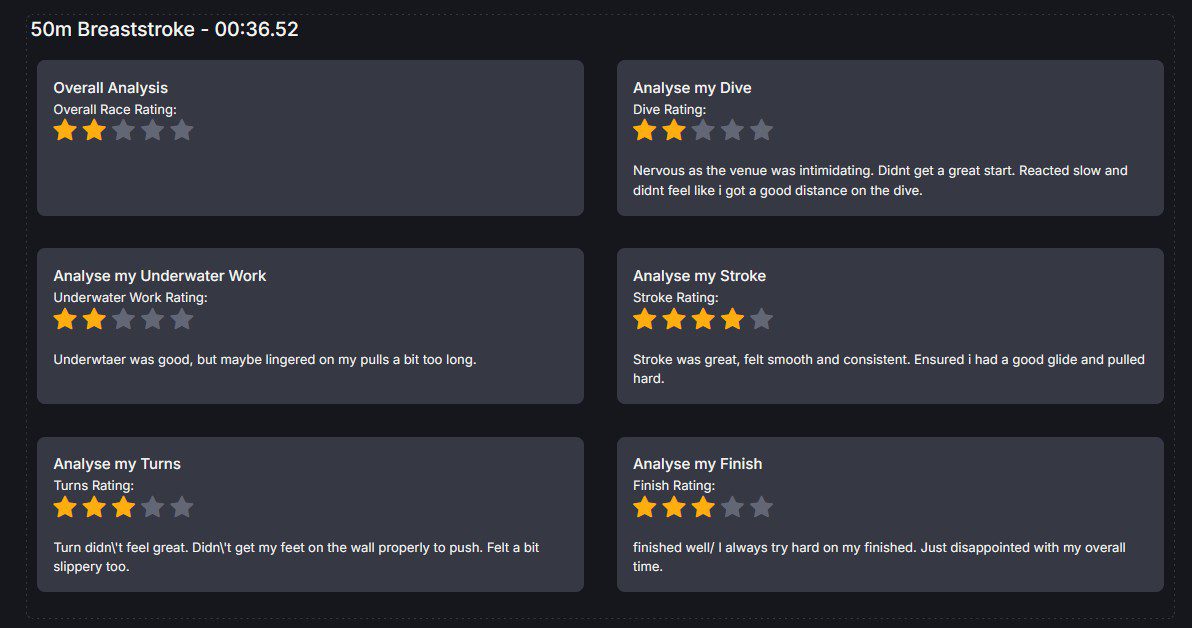
Your race review shouldn’t take longer than a few minutes. On average 3 minutes is a good guide. Below is an actual swimmer review from within Trackaswim that we have been allowed to show.
Step 4: Pick ONE focus for the next race (not five)
Trackaswim reviews are most effective when you choose a single improvement target. Examples:
“First 10m underwater discipline”
“Turn speed into breakout”
“Finish timing (no glide)”
If you try to fix everything, you will end up fixing nothing and getting frustrated. One focus per race is how you build momentum. Ensure you talk this through with you coach and ask them to build something into your training programme. After a few races you should be able to write more positively and then look to move onto the next area to review. All of this minor improvements will help you focus in on those valuable hundredths of a second that can mean the difference between 1st and 5th place.
What to look for across multiple races (this is where improvement becomes obvious)
Same rating drops under pressure (e.g., turns always 2–3 stars at meets, 4–5 in training)
Strong execution but time not moving (often pacing, race plan, or event choice)
One weakness dominating outcomes (underwaters or turns are common “hidden seconds”)
This is exactly why Trackaswim is swimmer-led: you’re not just collecting results — you’re learning how you race. The stars system gives you a clear indication of where you need to start looking. Lower star scores means you are not happy with that area of your racing. The written text reviews then give you the depth to interrogate these scores and understand what is going wrong.
| Pattern Noticed | What it usually means | What to do next |
|---|---|---|
| Low scores across my last 5 races for my dive. | this could be physical or emotional. Some swimmers don’t like everyone watching them. Alternatively it could just be their reaction times are slow. | Talk with the swimmer and understand if they are nervous or concerned about being up on the blocks at the start of the race. If reaction times are slow, do plenty of land based work on improving overall reaction times in general. |
| Constant disappointment in my finishes | The swimmer may be tired? They may not be fully aware of where they are in the pool? Did they put their head down too early to sprint? | Check the video footage if available. This will show how the swimmer has entered the final stage of the race. Did they start sprinting too early? Do a full review with coaches to fully understand. |
| Consistent ratings in stroke reviews | If the stroke reviews are consistently high, this indicates the swimmer is comfortable in the main stroke element of the race. | Keep monitoring this to keep the scores high. No adjustment is needed to this aspect of the race until all areas are at the same level overall. |
How to use Trackaswim reviews alongside training (so training has a purpose)
For parents: the best way to help (without becoming the second coach)
Ask: “What felt different today?” (not “why was it slow?”)
Help them write the comment in Trackaswim (their words, not yours)
Celebrate execution wins: a 4-star turn under pressure is progress, even if the time isn’t a PB yet
Confidence is built from evidence. Trackaswim stores that evidence.
Common mistakes (and how Trackaswim prevents them)
Mistake: changing everything at once → the review pushes one clear focus.
Mistake: forgetting what happened → reviews are saved per race, season-long.
Quick checklist: your 3-minute Trackaswim post-race review
Rate: Start / Underwater / Stroke / Turns / Finish
Write 1–3 sentences: what happened → why it mattered → what I’ll try next time
Choose ONE focus for the next race
How soon after a race should I do my Trackaswim review?
Same day is best — within an hour if possible, or that evening while it’s fresh.
What if I don’t know what went wrong?
Start with honest ratings. Your comment can be simple: “Felt flat; breathing got messy at 35m.” Patterns across races will reveal the real issue.
Should parents write the review?
No — the swimmer should own it. Parents can help prompt and capture the swimmer’s words.
How long should a Trackaswim race comment be?
Short. 1–3 sentences is enough if it includes “what happened” and “what I’ll try next time”.
What should I write in a swim race review?
The main part of this is be honest. Try to put good information that you can look back on and it means something.
A good example:
“I felt flat and tired. Struggled to get any energy into my stroke today. Could have done with doing fewer races maybe.”
A Bad Example:
“I was tired. Stroke was bad. Didn’t win”
Try to make the review meaningful so that when you read it back in days or weeks, you can relate to what happened.
How do I know what to work on after a race?
This is the question to ask your coach too. Trackaswim helps you capture the evidence; your coach helps you decide the training. We have always said that we will not look to replace a coach. They have a vital role in your performance.
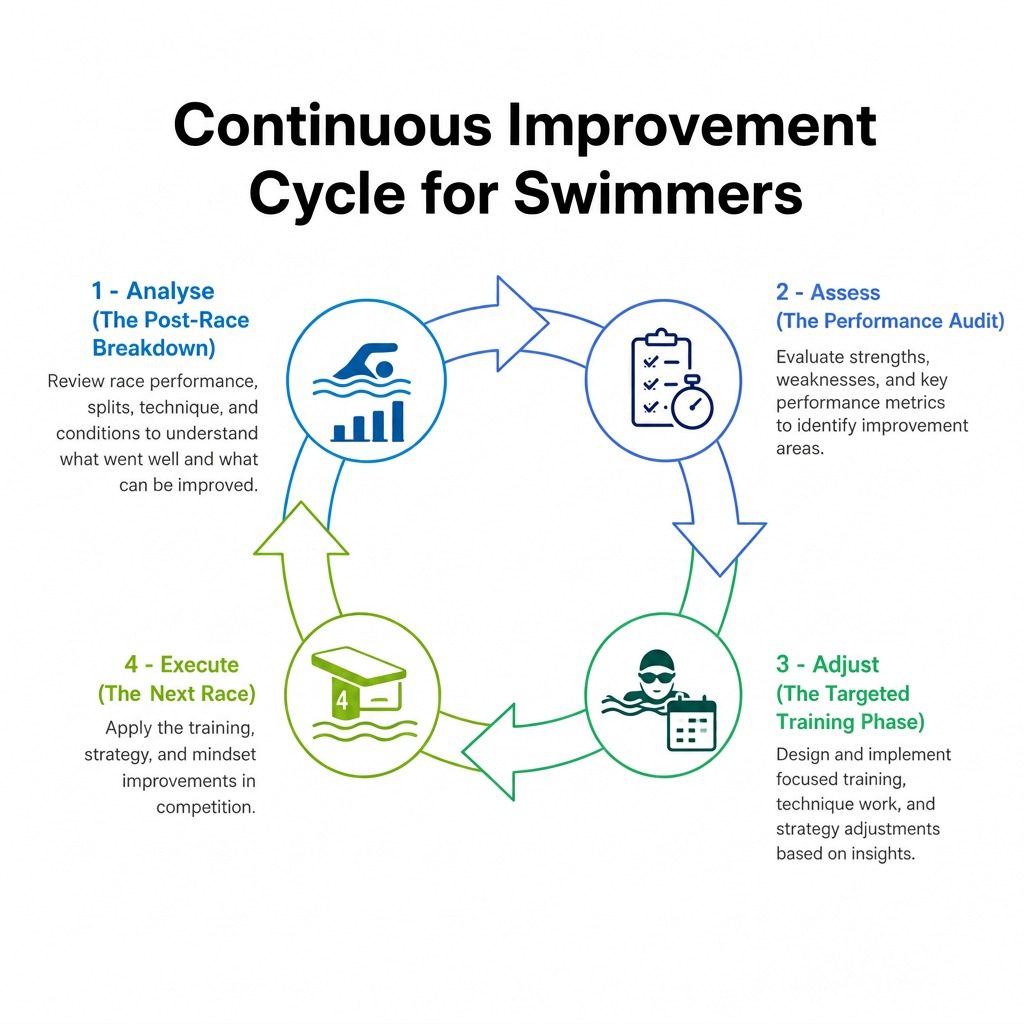
Sit down with your coach, and go through the reviews and the video footage if you can. Having a history of review will create patterns, patterns show problems, problems generate a training plan. See the Swimmer’s Continuous Improvement Loop process above.
Trackaswim is a tool that shows you how to analyse a swim race, we will not give you competitive swimming tips, however we will give you access to the tolls to do professional swimming performance tracking and record your race feedback, enabling you and your coaches to produce your training plan that is focused and meaningful for you to progress in areas that need progression.